Introduction to AI and Generative AI
Empower yourself with a clear understanding of AI and Generative AI fundamentals and analogies to the human brain so you can better understand how modern AI systems work.
Welcome & Series Overview
Purpose & Goals
This course aims to build confidence in using Generative AI technologies like CoPilot to boost your productivity and enhance your daily workflows.
Agenda Overview
Throughout this series, we'll cover key topics from fundamentals to practical applications of Generative AI in professional settings.
Interactive Expectations
Each session includes live demonstrations and Q&A portions to ensure you gain hands-on experience with these powerful tools.
Fundamentals
GenAI Basics & Neural Networks
Applications (Coming Soon)
Real-world Use Cases
Advanced (Coming Soon)
Integration & Workflows
Evolution of AI
Historical Perspective
Artificial Intelligence has evolved dramatically since its conceptualization in the 1950s, progressing from theoretical frameworks to the sophisticated systems we use today.
Key Milestones
The journey from early AI concepts to modern generative models spans decades of research breakthroughs, with each milestone building upon previous innovations.
Current Landscape
Today's AI landscape is dominated by Large Language Models and generative systems that can understand and create human-like content across multiple modalities.
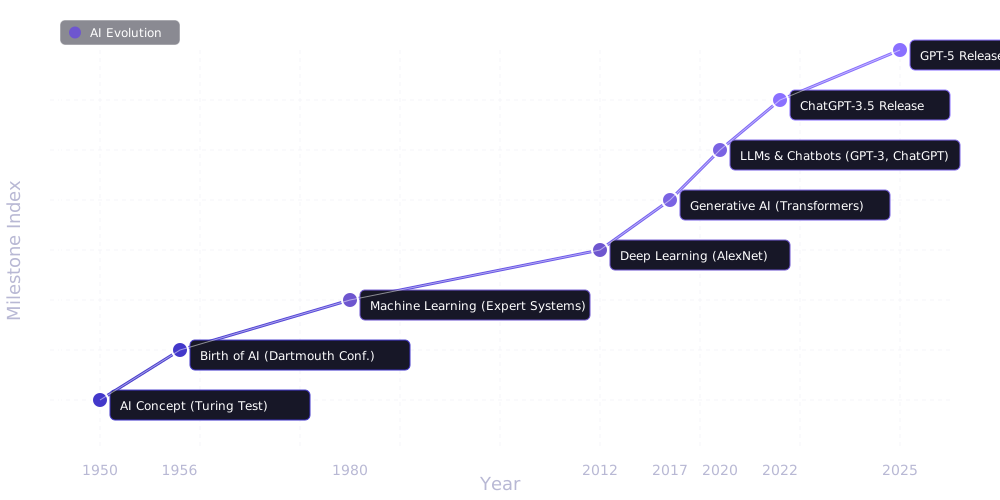
Alan Turing proposed the Turing Test to determine whether a machine could exhibit human-like intelligence, laying the foundation for defining machine intelligence.
The Dartmouth Conference officially coined the term "Artificial Intelligence," marking the beginning of focused AI research and development.
The rise of Expert Systems introduced rule-based AI programs designed to mimic human decision-making in specialized fields like medical diagnosis.
AlexNet demonstrated the power of deep neural networks for image recognition, proving that multi-layered neural networks could outperform traditional machine learning.
The Transformer architecture enabled AI to process entire sequences at once, leading to breakthroughs in natural language processing and generation.
Large Language Models like GPT-3 brought powerful text generation capabilities, making AI-powered conversation accessible to businesses and the public.
An improved version with better accuracy, faster responses, and more nuanced conversations, marking a shift toward more interactive and useful AI.
OpenAI's o1/o3 and DeepSeek R1 introduced chain-of-thought reasoning. GPT-5 launched in August. Claude Opus 4 and Sonnet 4 debuted in May. Agentic AI emerged with autonomous multi-step task completion and tool use.
Claude Opus 4.6, Gemini 3 Deep Think, and GPT-5.3-Codex push frontiers with multi-agent orchestration, million-token context windows, 48.4% on Humanity's Last Exam, and mechanistic interpretability breakthroughs.
The Economics of Intelligence
Intelligence at Zero Cost
As compute costs decline exponentially, we're witnessing the democratization of artificial intelligence. What once required million-dollar supercomputers can now be achieved with affordable hardware, making AI accessible to organizations of all sizes.
Implications for Society
The plummeting cost of compute is driving a paradigm shift in how AI integrates into every aspect of society. DeepSeek R1 proved frontier-level reasoning could match OpenAI's o1 for just $5.6M in GPU hours, while open-source models like Llama 4 and Mistral Large 3 continue to close the gap with proprietary systems.
Future Trajectory
The economics of AI are following an exponential curve that will continue to accelerate innovation. This trajectory suggests we're only at the beginning of understanding how accessible AI will transform industries, scientific discovery, and human potential.
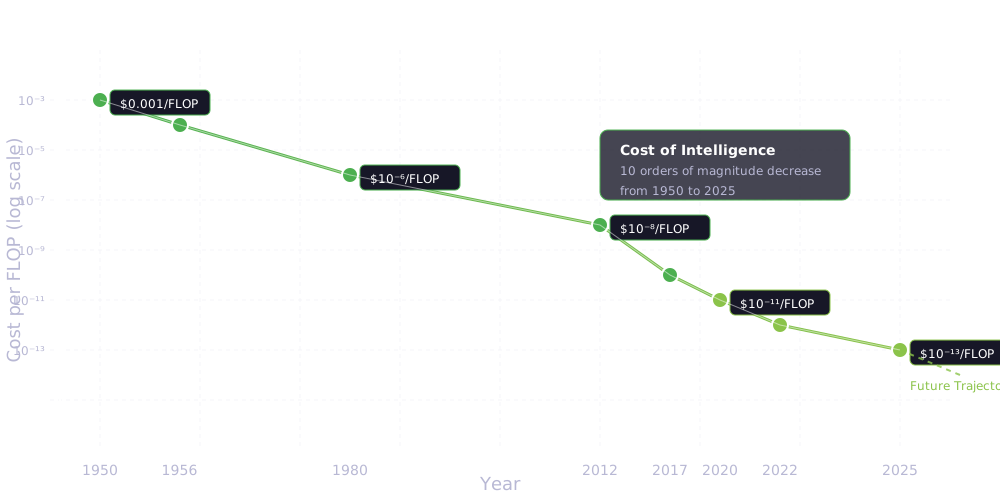
Global computing operations per day likely exceed 10²⁶ - 10²⁸ FLOPS (2025)
AI Becomes Ubiquitous
AI will be embedded in everyday devices and systems, from personal assistants to smart cities, making intelligence a utility as common as electricity.
Acceleration of Innovation
Lower costs enable more experimentation, leading to faster iterations and breakthroughs in medicine, engineering, and scientific research.
Democratization of AI
AI is no longer just for big tech; smaller companies, educational institutions, and developing nations can now leverage AI for growth.
Evolution Beyond Generative AI
As compute becomes cheaper, AI will develop real-time inference and reasoning capabilities, shifting from reactive to proactive systems.
Human Augmentation
AI will transition from being a tool to a true collaborator, enhancing human abilities in creativity, decision-making, and problem-solving.
Scientific Revolution
AI will accelerate discoveries in materials science, drug development, and climate modeling, solving problems once thought to take decades.
Key AI Terminology & Definitions
Understanding the AI Ecosystem
The field of artificial intelligence is filled with specialized terminology that often overlaps. This glossary provides clear definitions from leading experts to help you navigate conversations about AI technologies.
From Technical to Applied
These definitions show the nested relationship between AI concepts, from the broader field of artificial intelligence to more specialized applications like machine learning, generative AI, and large language models.
Evolving Terminology
As the field rapidly advances, terminology evolves—what was once considered cutting-edge deep learning may now be referred to as "traditional AI" in some contexts. Understanding these terms helps track the evolution of the technology.
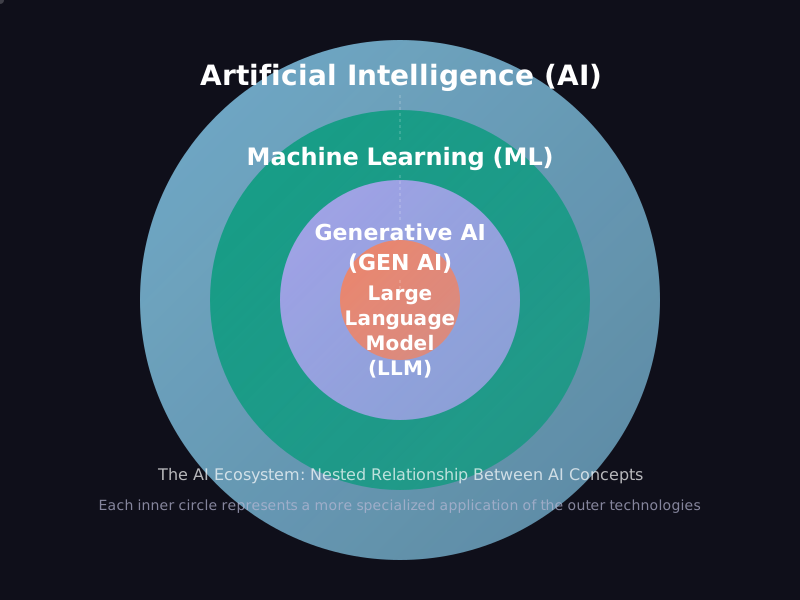
Artificial Intelligence (AI)
Computer systems designed to perform tasks that typically require human intelligence. These systems can perceive their environment, learn from data, and take actions to achieve specific goals.
Example: Smart assistants like Siri, Alexa, and Google Assistant that can understand voice commands and perform various tasks.
Machine Learning (ML)
A subset of AI that allows systems to learn and improve from experience automatically without being explicitly programmed. ML algorithms build models based on sample data to make predictions or decisions.
Example: Netflix and Spotify recommendation systems that learn from your viewing or listening habits to suggest new content.
Deep Learning
A specialized type of machine learning that uses artificial neural networks with multiple layers (hence "deep") to progressively extract higher-level features from raw input data, mimicking how the human brain processes information.
Example: Face recognition in smartphone cameras and social media that can identify individuals in photos with remarkable accuracy.
Large Language Models (LLMs)
Advanced AI systems trained on vast amounts of text data that can understand, generate, and manipulate language. They work by predicting the most likely next word in a sequence, enabling them to write essays, answer questions, and more.
Example: ChatGPT and Claude that can answer questions, write essays, and engage in natural-sounding conversations.
Rule-based Systems
Early AI programs that use explicit "if-then" rules created by human experts to make decisions. Unlike learning systems, rule-based systems follow predetermined logic paths and cannot adapt to new situations without being reprogrammed.
Example: Spam filters that use predefined rules to determine whether an email is spam based on specific keywords or sender information.
Generative AI
AI systems that can create new content such as text, images, music, and videos that didn't exist before. Unlike traditional AI that classifies or predicts data, generative AI produces original outputs based on patterns learned from training data.
Example: DALL-E and Midjourney that create realistic images and artwork based on text descriptions provided by users.
Neural Networks
Computing systems inspired by biological brain structures, consisting of interconnected nodes ("neurons") that process and transmit information. They excel at recognizing patterns and can learn to perform tasks by analyzing example data.
Example: Google Translate uses neural networks to provide increasingly accurate translations between languages, capturing nuances and context.
Agents
AI systems that can operate autonomously to achieve specific goals on behalf of users. They can perceive their environment, make decisions based on that information, and execute tasks with minimal human intervention.
Agentic AI
Advanced autonomous AI systems that can chain together multiple steps, interact with software or services, make decisions, and adapt their approach based on outcomes. Agentic AI can complete complex tasks much like a personal assistant.
Brain vs. Neural Network: Understanding the Analogy
Biological Neurons vs. Artificial Neurons
Just as the human brain processes information through interconnected neurons, artificial neural networks use mathematical representations of neurons to process data and identify patterns.
Synaptic Connections & Weights
The brain's synapses strengthen with repeated use, similar to how neural network connections adjust their "weights" during training to improve outcomes over time.
Learning & Adaptation
Humans refine skills through practice and experience; similarly, AI models improve through iterative training on diverse examples, gradually enhancing their ability to generate relevant outputs.
Human Neural System
- 86 billion neurons
- Chemical/electrical signals
- Learns through experience
Artificial Neural Network
- Billions of parameters
- Mathematical operations
- Learns through training data
What is Generative AI?
Definition & Scope
Generative AI refers to technologies that create new content (text, images, code, etc.) based on patterns learned from existing data. These systems automate creative and repetitive tasks, enabling unprecedented productivity.
Business Impact
GenAI transforms traditional workflows by saving time, enhancing accuracy, and unlocking new business insights that were previously inaccessible or time-consuming to obtain.
GenAI in Action
Modern generative AI systems integrate directly into familiar applications, helping you draft content, summarize documents, and analyze data with simple natural language prompts.
Traditional vs. AI-Augmented Workflow
- 4 hrs Manual document summarization
- 2 hrs Email draft and revision
- 3 hrs Data analysis and insight generation
- 30 min AI-assisted summarization
- 20 min AI email drafting + review
- 45 min AI-powered data insights
How Generative AI Works
Input Process – Prompt Engineering
Crafting precise, detailed prompts is key to getting high-quality outputs from generative AI. Learning to communicate effectively with AI systems is a skill that improves with practice.
Training Process – Data & Algorithms
AI models like those powering CoPilot are trained on vast datasets, including business content, to understand context, language, and domain-specific knowledge relevant to your work.
Output Generation – From Data to Content
When you provide a prompt, the AI processes it through its neural network, drawing on patterns from its training to generate contextually relevant content that meets your needs.
User Prompt
"Draft a quarterly report summary highlighting key financial metrics"
AI Processing
Pattern recognition, context analysis, content generation
Generated Output
Structured summary with key metrics and insights highlighted
What Can You Generate Using GenAI?
Text
- Business reports
- Creative stories
- Marketing copy
- Academic papers
Images
- Photorealistic scenes
- Art in various styles
- Product visualizations
- Design concepts
Code
- Application functions
- Website components
- Script automation
- API integrations
Audio/Video
- Music compositions
- Voice synthesis
- Video concepts
- Sound effects
Text Generation & Writing
From professional emails and marketing copy to creative stories and technical documentation, GenAI can produce various text formats tailored to specific audiences, tones, and purposes.
Visual & Design Content
Create images, illustrations, design mockups, and visual concepts by describing what you envision. AI can generate entirely new visuals or variations on existing design themes.
Code & Technical Solutions
Generate functioning code in various programming languages, debug existing code, and create technical solutions to specific problems with simple natural language instructions.
Media & Interactive Content
Produce audio content, music compositions, voiceovers, video concepts, and even interactive experiences by defining parameters and creative direction.
Major Players in the GenAI Landscape
Foundation Model Developers
These organizations create the large language models and multimodal AI systems that power most generative AI applications. They invest billions in research, training infrastructure, and dataset curation.
Chip Manufacturers
The computing hardware that enables AI model training and inference is crucial to the GenAI ecosystem. These companies design specialized processors optimized for AI workloads.
Application & Platform Providers
Building on foundation models, these companies develop user-friendly interfaces and specialized applications that make generative AI capabilities accessible to businesses and consumers.
Open Source Communities
These collaborative ecosystems democratize access to cutting-edge AI by developing freely available models, tools, and frameworks that reduce barriers to entry in the field.
Foundation Models
Chip Manufacturers
Cloud & Infrastructure
Latest Foundation Models
State-of-the-Art AI Systems
The AI landscape evolves rapidly with new models released regularly. Each company's flagship model represents its latest research and capabilities in the field.
Open vs Closed Ecosystems
While some companies prioritize tightly controlled access to their models (closed source), others make their models available to the public (open source), often with specific licensing terms.
Geographic Availability
Access to advanced AI models varies significantly by region due to multiple factors:
- Regulatory Compliance: Companies must navigate complex regional regulations like the EU AI Act, GDPR in Europe, or data sovereignty laws in various countries. This often results in regional versions of models with different capabilities.
- Market Strategy: Model providers typically roll out access gradually, starting with their primary markets (often US-based) before expanding globally.
- Infrastructure Requirements: Some regions may lack the technical infrastructure needed to support high-demand AI services, limiting effective deployment.
- Export Controls: National security concerns may restrict access to cutting-edge AI capabilities in certain regions due to dual-use technology controls.
Open source models provide a partial solution to these geographic limitations, as they can be deployed locally without API restrictions—though they often require significant technical expertise and computing resources.
Open vs. Closed Source Model Comparison
Humanity's Last Exam: AI Performance Benchmarks
The Race for Human-Level Performance
As AI models grow more sophisticated, researchers use standardized tests to measure their capabilities against human performance. The "Humanity's Last Exam" benchmark evaluates models on complex reasoning, knowledge application, and problem-solving.
2026: A Leap to Near-50% Accuracy
The 2026 generation of models has shattered previous records. Google's Gemini 3 Deep Think leads Humanity's Last Exam at 48.4%, followed by Gemini 3 Pro at 37.2%, Claude Opus 4.6 at 36.7%, and GPT-5.2 at 35.4%. In roughly one year, scores climbed from single digits to the high 30s-40s.
Implications for Society
With frontier models now achieving agent-level autonomy and million-token contexts, 2026 marks the shift from AI as a tool to AI as a collaborator. Multi-agent teams (Claude Agent SDK, OpenAI Agents API), mechanistic interpretability breakthroughs, and new AI regulations (SB 53, TRAIGA) are reshaping industries.
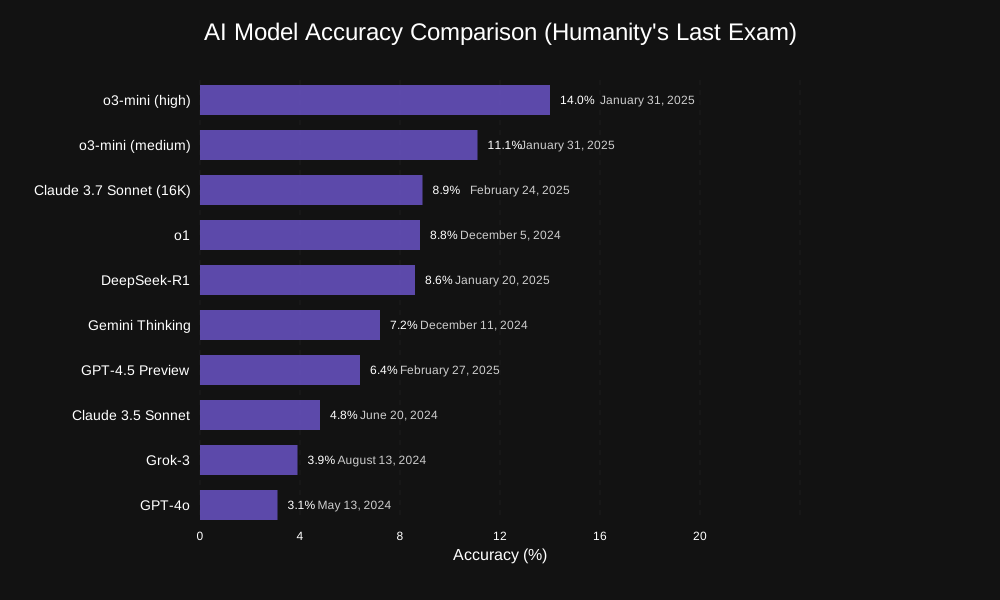
Higher percentages indicate better performance. 2026 models show dramatic leaps over 2025 predecessors
Featured models: GPT-4o (2.7%), Grok-3 (3.9%), DeepSeek-R1 (8.6%), o3-mini (14.0%), GPT-5 (25.0%), GPT-5.2 (35.4%), Claude Opus 4.6 (36.7%), Gemini 3 Pro (37.2%), Gemini 3 Deep Think (48.4%)
Record-Breaking Scores
Gemini 3 Deep Think leads Humanity's Last Exam at 48.4%, with Claude Opus 4.6 at 36.7% and GPT-5.2 at 35.4%. In one year, scores jumped from single digits to nearly 50%. Models demonstrate near-expert reasoning across law, medicine, mathematics, and software engineering.
Multistep Reasoning
Recent models excel at breaking down complex problems into logical sequences, with each generation showing improved capacity to maintain consistency across extended reasoning chains.
Model Efficiency
The trend toward smaller yet more capable models (as seen with o3-mini) suggests that architectural improvements are now outpacing raw scale, potentially democratizing access to powerful AI capabilities.
AI Image Generator NEW
Create stunning AI-generated images with our new tool
Prompt Engineering Lab NEW
Compare responses from different AI models with adjustable parameters
GenAI Vocabulary NEW
Master 58+ essential GenAI terms with definitions, analogies, and examples
AI Insights Blog NEW
Stay updated with the latest AI news, tutorials, and expert analysis